
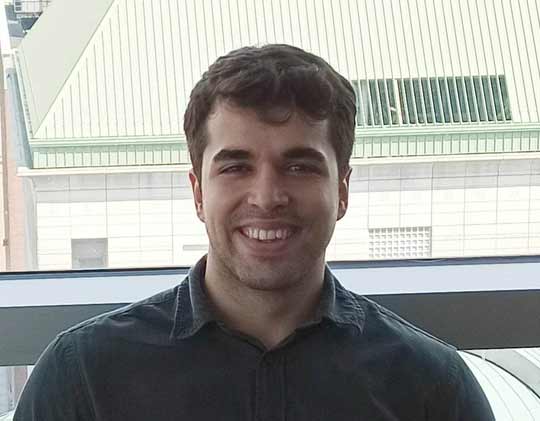
Researcher
Robotics & Autonomous Systems,
Royal Military Academy
Address
Avenue De La Renaissance 30, 1000 Brussels, Belgium
Contact Information
Call: –
Email: Emmanouil.Maroulis@mil.be
Emmanouil “Manos" is a robotics researcher at the Robotics & Autonomous Systems unit of the Department of Mechanics of the Belgian Royal Military Academy.
He obtained two MSc diplomas in electrical & computer engineering at University of Thessaly in 2021 and 2023 respectively.
While finalizing his first MSc studies, he started working at Network Implementation Testbed Laboratory where he undertook projects for throughput optimization between UAVs, UAV mesh network optimization and fault tolerant distributed systems. Also, he developed several autonomous ground/aerial vehicles, which included programming, sensor integration/hardware setup.
In 2023, Manos joined the Belgian Royal Military Academy to participate in the iCUGS project, responsible for developing hybrid methods for traversability analysis, local swarming algorithms and an air to ground map workflow for UGVs.
Publications
2026
- E. Maroulis, E. {Le Flécher}, K. Hasselmann, and G. {De cubber}, “Dynamic Factor Precision in Gaussian Belief Propagation: A Tracking use Case," IEEE Signal Processing Letters, vol. 33, p. 2061–2065, 2026.
[BibTeX] [Abstract] [DOI]
In this paper, we investigate a consensus-based distributed Kalman filter for single-target tracking over loopy communication graphs using Gaussian belief propagation. Each node (tracker) maintains a local Kalman filter and exchanges Gaussian messages with its neighbors on a factor{–}graph, implementing a distributed fusion of measurement increments. Instead of the usual static factor precision Lij=βI, we introduce state-dependent factor precisions that adapt to the local uncertainty and network topology. We further derive simple local bounding rules that guarantee walk-summability of an associated Gaussian surrogate model. In simulations with range-dependent measurement noise and increasingly dense communication graph topologies, a proposed dynamic precision achieves better normalized estimation error square calibration and mean-squared error than static baselines, and remains resilient even in over-connected networks.
@article{db4b9f7b3d884d74b9fd75aa88d76c08,
title = "Dynamic Factor Precision in Gaussian Belief Propagation: A Tracking use Case",
abstract = "In this paper, we investigate a consensus-based distributed Kalman filter for single-target tracking over loopy communication graphs using Gaussian belief propagation. Each node (tracker) maintains a local Kalman filter and exchanges Gaussian messages with its neighbors on a factor{\textendash}graph, implementing a distributed fusion of measurement increments. Instead of the usual static factor precision Lij=βI, we introduce state-dependent factor precisions that adapt to the local uncertainty and network topology. We further derive simple local bounding rules that guarantee walk-summability of an associated Gaussian surrogate model. In simulations with range-dependent measurement noise and increasingly dense communication graph topologies, a proposed dynamic precision achieves better normalized estimation error square calibration and mean-squared error than static baselines, and remains resilient even in over-connected networks.",
keywords = "Consensus, Gaussian belief propagation, Kalman filter, distributed state estimation, factor-graph",
author = "Emmanouil Maroulis and \{Le Fl{\'e}cher\}, Emile and Ken Hasselmann and \{De cubber\}, Geert",
year = "2026",
month = may,
day = "14",
doi = "10.1109/LSP.2026.3693204",
language = "English",
volume = "33",
pages = "2061--2065",
journal = "IEEE Signal Processing Letters",
issn = "1070-9908",
unit={meca-ras},
project={CUGS, iMUGS2}
}
2025
- E. Maroulis, D. Hawari, K. Hasselmann, E. Le Flécher, and G. De Cubber, “Experimental Evaluation of Roadmap-Based Map Generation with Continuous-Time Conflict-Based Search for Multi-Agent Pathfinding," in IEEE International Conference on Autonomous Robots and Agents, ICARA, 2025, p. 380–387.
[BibTeX] [Abstract] [Download PDF] [DOI]
This article presents an experimental evaluation of a Multi-Agent Pathfinding (MAPF) approach for large-scale robotic fleets operating in diverse outdoor environments. We generated three distinct types of roadmap graphs: Constrained Delaunay Triangulation (CDT), Voronoi Diagram (VD), and Grid-derived from an obstacle file, and assessed their quality using metrics obtained from graph theory. Then, the performance of the Continuous-time Conflict-Based Search (CCBS) algorithm was evaluated across three different environmental maps, considering practical performance metrics including makespan and failure rate. Subsequently, the roadmap generation methods were ranked based on CCBS performance in similar scenarios using the Friedman statistical test. The results indicate that CDT outperforms both VD and Grid maps, even though it does not exhibit the best graph metrics in many environments. CDT’s superior performance is attributed to its enhanced interconnectedness and the availability of multiple pathways, as evidenced by its balanced metrics and structural properties. We show that CDT is the most efficient and reliable roadmap generation technique for multiagent systems under our experimental conditions making it a preferred choice for robust pathfinding.
@inproceedings{34774d01cc3341398188fc8353028be2,
title = "Experimental Evaluation of Roadmap-Based Map Generation with Continuous-Time Conflict-Based Search for Multi-Agent Pathfinding",
abstract = "This article presents an experimental evaluation of a Multi-Agent Pathfinding (MAPF) approach for large-scale robotic fleets operating in diverse outdoor environments. We generated three distinct types of roadmap graphs: Constrained Delaunay Triangulation (CDT), Voronoi Diagram (VD), and Grid-derived from an obstacle file, and assessed their quality using metrics obtained from graph theory. Then, the performance of the Continuous-time Conflict-Based Search (CCBS) algorithm was evaluated across three different environmental maps, considering practical performance metrics including makespan and failure rate. Subsequently, the roadmap generation methods were ranked based on CCBS performance in similar scenarios using the Friedman statistical test. The results indicate that CDT outperforms both VD and Grid maps, even though it does not exhibit the best graph metrics in many environments. CDT's superior performance is attributed to its enhanced interconnectedness and the availability of multiple pathways, as evidenced by its balanced metrics and structural properties. We show that CDT is the most efficient and reliable roadmap generation technique for multiagent systems under our experimental conditions making it a preferred choice for robust pathfinding.",
keywords = "Measurement , Automation , Reliability theory , Graph theory , Path planning , Robots , Multi-agent systems",
author = "Emmanouil Maroulis and Danial Hawari and Ken Hasselmann and Le Flécher, Emile and De Cubber, Geert",
year = "2025",
month = may,
day = "5",
doi = "10.1109/ICARA64554.2025.10977707",
language = "English",
pages = "380--387",
booktitle = "IEEE International Conference on Autonomous Robots and Agents, ICARA",
issn = "2767-7745",
url = "https://ieeexplore.ieee.org/document/10977707",
unit= {meca-ras},
project= {CUGS, ANIMUS, AIDEDEX, CONVOY}
}
2023
- G. De Cubber, E. Le Flécher, A. La Grappe, E. Ghisoni, E. Maroulis, P. Ouendo, D. Hawari, and D. Doroftei, “Dual Use Security Robotics: A Demining, Resupply and Reconnaissance Use Case," in IEEE International Conference on Safety, Security, and Rescue Robotics, 2023.
[BibTeX] [Download PDF]@inproceedings{ssrr2023decubber, title={Dual Use Security Robotics: A Demining, Resupply and Reconnaissance Use Case}, author={De Cubber, Geert and Le Flécher, Emile and La Grappe, Alexandre and Ghisoni, Enzo and Maroulis, Emmanouil and Ouendo, Pierre-Edouard and Hawari, Danial and Doroftei, Daniela}, booktitle={IEEE International Conference on Safety, Security, and Rescue Robotics}, editors ={Kimura, Tetsuya}, publisher = {IEEE}, year = {2023}, vol = {1}, project = {AIDED, iMUGs, CUGS}, location = {Fukushima, Japan}, unit= {meca-ras}, doi = {}, url={https://mecatron.rma.ac.be/pub/2023/SSRR2023-DeCubber.pdf} }